PART 3
A painful murmur moved through the chapel.
“I told him he was being ridiculous. I said we’d be laughing about all this in ten years. I told him he would be standing at my wedding, embarrassing me in front of my future wife, and reminding everyone that I used to cry whenever my mother left me at school.”
A few people smiled through their tears.
Theo managed a small, trembling smile, too.
“Jack laughed. Then he looked at me and said, ‘I’m serious, man.’”
Theo paused, staring at the coffin.
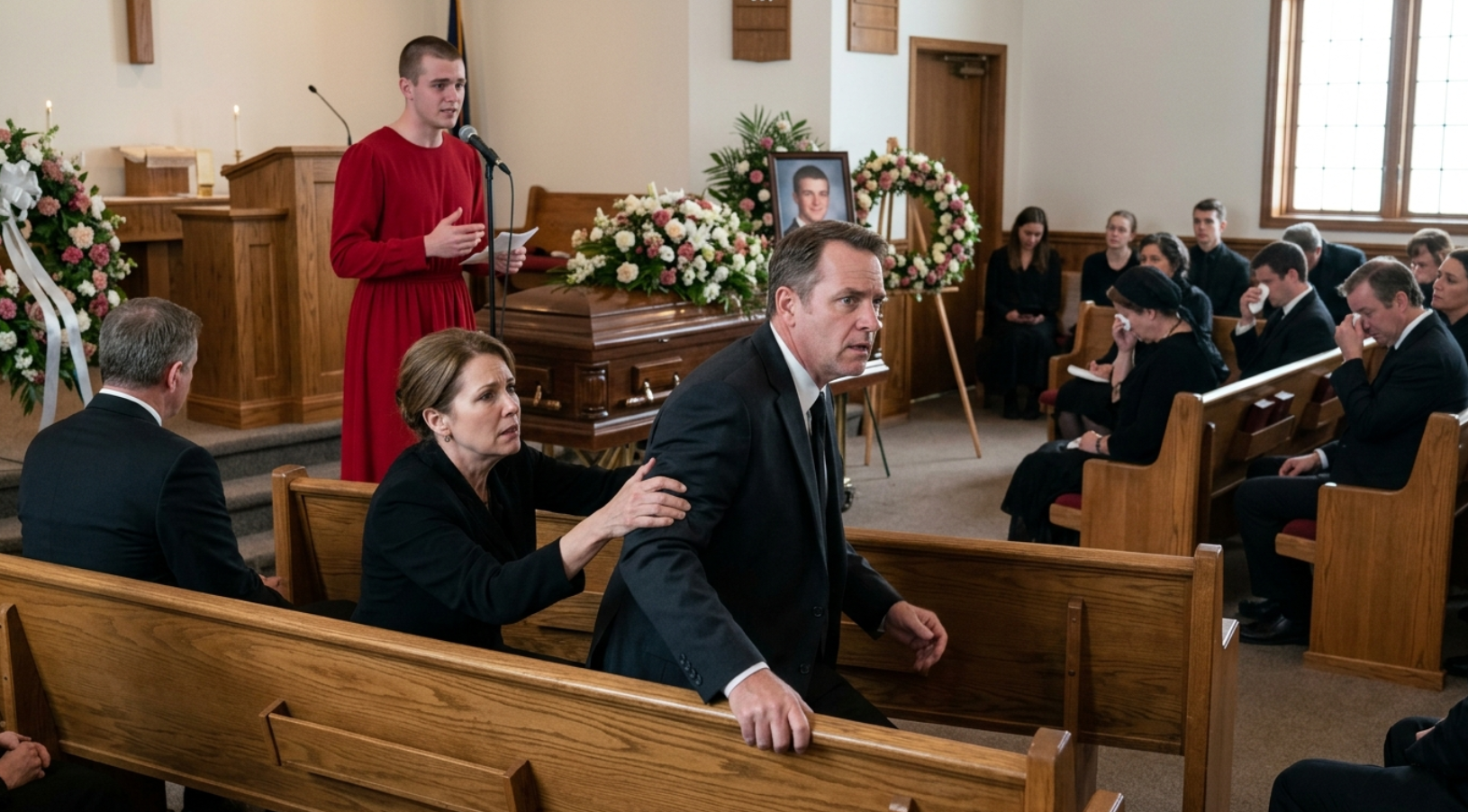
“He asked me to wear a red dress to his funeral.”
My husband stiffened beside me.
I felt as though the entire room had tilted.
“A dress?” Daniel whispered.
Theo nodded.
“He told me that when he was little, he once saw a photograph of a woman wearing a beautiful red dress. He said she looked fearless. She looked like someone who didn’t care if the whole world was staring at her.”
Theo took a breath.
“Jack told me he wanted one person at his funeral who wasn’t afraid to look different. Someone who would make people uncomfortable enough to stop pretending they understood everything about another person.”
He glanced at the guests.
“But that wasn’t the most important part.”
His fingers tightened around the edges of the podium.
“Jack told me he was afraid that after he died, people would remember him only as the sick boy. The boy who lost his hair. The boy who couldn’t walk upstairs without getting exhausted. The boy everyone felt sorry for.”
My eyes filled with tears.
“He said, ‘I don’t want people to remember me because I died, Theo. I want them to remember that I lived.’”
A sob escaped someone near the back.
Theo lowered his head.
“He made me promise to wear something bright. Something impossible to ignore. And he told me that if anybody laughed, stared, or whispered, I wasn’t allowed to explain myself until I had finished telling everyone what he wanted them to hear.”
For the first time since Theo had entered the chapel, I understood.
The red dress wasn’t a joke.
It wasn’t disrespect.
It was the final gift my son had asked his best friend to give him.
Daniel slowly sat back down.
I reached for his hand, but he wasn’t looking at me. He was staring at Theo with an expression I had never seen on his face before.
Regret.
Theo continued.
“Jack also told me something else. Something I promised not to share until today.”
He reached into the pocket of the dress and pulled out a folded piece of paper.
“He wrote this himself.”
My heart stopped.
I recognized the handwriting immediately.
It was Jack’s handwriting, the same uneven letters he used on birthday cards and school assignments when his hands were shaking too badly to write properly.
Theo unfolded the paper.
“Dear Mom and Dad,” he began.
My knees weakened.
“I’m sorry I never told you this while I was alive. I know you were already carrying enough pain, and I didn’t want to make you sadder than you already were.”
Daniel covered his mouth.
Theo struggled through the next sentence.
“Mom, I know you sometimes sit beside my bed at night and think I’m sleeping. I hear you crying. Dad, I know you go into the garage when you need to cry because you don’t want Mom to see you.”
Daniel bent forward.
A sound came from his throat that I had never heard before. It was the sound of a father whose heart had finally broken in front of other people.
Theo stopped reading, allowing us a moment.
Then he continued.
“I need you both to know that I was never angry about being sick. I was angry that I couldn’t do all the things I thought I would do. I wanted to travel. I wanted to drive a car. I wanted to fall in love and get married. I wanted to be old enough to complain about my back hurting.”
A few people laughed softly through their tears.
“But I had something many people spend their whole lives looking for. I had people who loved me. I had a home where I never felt alone. I had a best friend who stayed even when things got ugly.”
Theo’s voice broke.
“And I had parents who gave me everything they could, even when they couldn’t give me the one thing I wanted most.”
I couldn’t breathe.
“I love you, Mom and Dad. Please don’t spend the rest of your lives thinking you should have done something differently. You took me to every appointment. You held my hand. You stayed awake when I couldn’t sleep. You fought for me when I was too tired to fight for myself.”
Theo wiped his eyes.
“Please don’t turn my death into a punishment for yourselves.”
I buried my face in Daniel’s shoulder.
For fourteen months, I had asked myself the same questions every night.
Had I noticed the symptoms too late?
Had I chosen the wrong hospital?
Should I have insisted on another treatment?
Should I have spent less time working and more time sitting beside his bed?
I had replayed every decision until even my happiest memories were covered in guilt.
And now my son, in his own handwriting, was asking me to stop.
Theo turned the page.
“There is one more thing Jack asked me to do,” he said quietly. “He wanted me to tell you what happened the night we talked about the red dress.”
He looked directly at Daniel.
“Mr. Harris, do you remember the night Jack asked you to teach him how to shave?”
Daniel nodded, unable to speak.
“He told me afterward that he had never seen you so happy. He said you treated him like he was a grown man, even though he could barely stand in front of the bathroom mirror.”
Theo swallowed.
“Jack told me that was the first time in months he had forgotten he was dying.”
Daniel began to cry harder.
“And Mrs. Harris, he told me about the night you sang to him when the pain was so bad he couldn’t sleep. He said you sang terribly.”
A fragile ripple of laughter passed through the room.
I let out a broken laugh of my own.
“That little rascal,” I whispered.
Theo smiled through his tears.
“He said he hoped you would keep singing, even after he was gone.”
Then Theo folded the letter and pressed it against his chest.
“Jack didn’t ask me to make you forget him. He asked me to help you remember him without feeling guilty every time you smiled.”
He stepped away from the microphone.
“But I think I have one more promise to keep.”
He looked toward Jack’s coffin.
“Jack, you told me to be brave today. I’m trying, buddy.”
Then he faced us.
“And if you’ll let me, I want to keep being part of this family. Not because I need someone to take care of me. Not because I feel sorry for myself. But because Jack spent his whole life making sure nobody felt alone, and I don’t think his job should end just because his heart stopped beating.”
Daniel stood.
For one terrible second, I thought he was going to ask Theo to leave again.
Instead, my husband walked down the aisle.
He stopped in front of the young man wearing the red dress.
Then Daniel pulled him into his arms.
“I’m sorry,” he whispered. “I should never have judged you before hearing what you had to say.”
Theo clung to him, sobbing.
Daniel held him tighter.
“You’re our boy, too.”
And just like that, the last of my anger disappeared.
I rose from my seat and joined them.
The three of us stood together in front of Jack’s coffin, crying so hard that none of us could speak.
For the first time that day, I didn’t feel like a mother who had lost everything.
I felt like a mother who still had someone to love.
But Theo hadn’t finished.
Because before he left the podium, he reached into his pocket one last time and pulled out a small envelope.
“Jack asked me to give you this after the funeral,” he said. “He said you would understand when you opened it.”
On the front, in Jack’s familiar handwriting, were four words:
FOR MOM AND DAD. TOGETHER.
And as Daniel and I opened the envelope, we discovered that our son had left us one final plan—one that would change the way we remembered him forever.
Inside the envelope was a photograph.
It showed Jack and Theo sitting on the floor of Jack’s bedroom, surrounded by colored paper, markers, and half-finished drawings. Jack looked thinner than I remembered, but he was laughing. Theo was making a ridiculous face at the camera.
On the back, Jack had written:
Remember this version of me.
Beneath the photograph was a second letter.
Daniel handed it to me because my fingers were shaking too badly to unfold it.
I began to read aloud.
“Mom and Dad,
“If you’re reading this, it means Theo kept his promise. I hope he didn’t look too ridiculous in that dress. Actually, I hope he looked ridiculous enough to make everyone talk about something other than how sad they are.”
A few people nearby laughed.
I pressed the letter against my chest for a moment before continuing.
“I’ve been thinking a lot about what happens when someone dies. Everybody talks about heaven, angels, and all the things they hope happen afterward. I don’t know exactly what happens. I’m only seventeen, and I haven’t figured out nearly enough about life to pretend I understand death.
“But I know one thing.
“I don’t want my story to end with a coffin.”
My tears fell onto the paper.
“So I asked Theo to help me start something.”
I looked at him.
He nodded quietly.
“There’s a box under my bed. Inside it are drawings, notes, and a list of things I wanted to do. Some are silly. Some are impossible. But a few of them might be things you can help other people do.”
Daniel wiped his face.
I continued reading.
“One of the things on the list is to help children who are sick and lonely. There are kids in hospitals who don’t get many visitors. Some have parents who live too far away. Some don’t have friends who understand what they’re going through.
“I want them to have what I had.
“I want them to have somebody who stays.”
The chapel was silent.
“I know you can’t save everybody, Mom and Dad. I know you couldn’t save me, either, even though you tried harder than anyone in the world.
“But maybe you can help somebody else have one more happy day.”
My voice cracked.
“Please don’t do it because you feel guilty. Don’t do it because you think you owe me something. Do it only if, one day, remembering me makes you want to share the love you gave me with somebody who needs it.”
The final paragraph was written in larger letters, as though Jack had struggled to fit it onto the page.
“And Mom, please buy yourself something beautiful. You’ve worn black and gray for months because you think you have to be strong. You don’t. You can wear red, too.
“Dad, please take Mom somewhere nice. And stop pretending you don’t cry in the garage. I can hear you from my bedroom.
“I love you both.
“Your annoying son,
“Jack.”
I couldn’t read another word.
I pressed the letter to my heart and wept.
Daniel wrapped his arms around me, and for several minutes, neither of us tried to be strong.
Then Theo quietly approached us.
“There’s something else,” he said.
I looked up.
“The box is still under Jack’s bed. I didn’t open it. I thought you should do that together.”
That evening, after the funeral guests had gone home, Daniel and I walked into Jack’s bedroom for the first time since his death.
Nothing had changed.
His favorite hoodie still hung over the chair. His books were stacked beside the bed. A half-empty bottle of water sat on the nightstand, and the curtains were still drawn the way he preferred them.
For a moment, I couldn’t move.
Daniel stood in the doorway, staring at the pillow where our son had rested his head during his final weeks.
“I don’t know how we’re supposed to do this,” he whispered.
I took his hand.
“Neither do I.”
We sat on the floor and pulled the box from beneath the bed.
Inside were dozens of drawings, photographs, handwritten notes, and a notebook titled:
THINGS I WANT TO LEAVE BEHIND.
The first page contained a list.
Some items were ordinary teenage dreams.
Learn to drive.
See the ocean at sunrise.
Eat an entire pizza without anyone telling me to slow down.
Travel somewhere with snow.
Others were harder to read.
Tell Mom she doesn’t have to apologize for being tired.
Tell Dad it’s okay to be scared.
Make sure Theo never thinks he has to face everything alone.
At the bottom of the page, Jack had written:
Help somebody feel less alone.
I stared at those words for a long time.
Then Daniel turned another page and found a drawing of a small building with bright windows, a garden, and a bench outside.
Above the door, Jack had written a name.
THE JACK HARRIS ROOM.
“What is this?” Daniel asked.
I looked closer.
It wasn’t a hospital. It looked like a comfortable room filled with books, games, art supplies, and chairs arranged in a circle.
Beside the drawing was a note.
Somewhere kids can go when they’re sick, scared, or waiting for someone they love to get better. A place where nobody has to pretend they’re okay.
Daniel sat very still.
“Do you think he wanted us to build this?”
“I think he wanted us to think about it.”
We spent the next hour looking through the notebook.
Jack had drawn plans for a small reading corner. He had written ideas for movie nights and art classes. He wanted volunteers to visit children in hospitals and bring them games, books, and conversation.
Some of his ideas were impractical. Some would cost more money than we could comfortably afford.
But the intention behind them was unmistakable.
Our son had spent his final months thinking about how to make life gentler for people he would never meet.
And I realized that while Daniel and I had been desperately trying to keep Jack alive, Jack had been thinking about how to help others live.
That night, we made our first decision.
We would not rush to build anything.
We would begin by listening.
The following week, Theo came over with his sister, Emily, who had lent him the red dress.
She was nervous about seeing us.
“I hope you don’t think I encouraged him to do something inappropriate,” she said. “Theo told me about Jack’s promise, and I thought he should keep it. I didn’t know it would upset everyone.”
I took her hands.
“You helped our son keep his word. I’ll always be grateful for that.”
Theo looked relieved.
Then he handed me Jack’s notebook.
“I think we should start with the hospital,” he said. “Not with a building. With the kids who are already there.”
Daniel nodded.
For the first time since the funeral, we had something to discuss besides arrangements, condolences, and the terrible silence waiting for us at home.
We contacted the hospital where Jack had received treatment and asked whether we could support its pediatric ward.
The staff suggested we begin with a small volunteer program: books, art materials, games, and visits for children who were able to receive visitors.
We bought picture books and sketchpads.
Theo recruited some of Jack’s classmates.
Emily offered to organize donations.
Daniel, who had barely spoken to anyone outside our family since Jack died, volunteered to help repair toys and assemble shelves.
And I began writing letters to families who wanted to share their experiences.
Our first visit was difficult.
A little boy named Oliver sat by the window with a knitted blanket over his legs. He was eight years old and had been in the hospital for weeks.
He barely looked at us when we entered.
Theo placed a box of colored pencils on the table.
“Do you like drawing?” he asked.
Oliver shrugged.
“Sometimes.”
“Jack liked it, too,” Theo said. “He was terrible at drawing dogs, though. Every dog he drew looked like a potato with legs.”
Oliver looked up.
“Really?”
“Absolutely. I have photographic evidence.”
Theo showed him one of Jack’s old drawings.
For the first time, Oliver smiled.
It was a small smile, but I felt it all the way to my heart.
I sat beside him and asked whether he wanted to draw something together.
He handed me a pencil.
“Can you draw a dinosaur?”
“I can try.”
“You have to make it scary.”
“I’ll do my best.”
My dinosaur looked more like a chicken wearing armor.
Oliver laughed.
It was the first time I had heard a child laugh in a hospital without immediately feeling the urge to cry.
When we left that afternoon, I stood in the parking lot and looked up at the hospital windows.
Daniel came to stand beside me.
“Do you think Jack would have liked it?” he asked.
I wiped my eyes.
“I think he would have told us my dinosaur was terrible.”
Daniel laughed.
And for the first time in weeks, I laughed with him.
It didn’t mean we missed Jack any less.
It meant we had discovered that love could still find somewhere to go.
Six months after the funeral, we organized a small gathering at the hospital to celebrate the children who had participated in our program.
We called it Jack’s Day.
There were balloons, homemade decorations, board games, and a table filled with books donated by local families.
Theo arrived early to help set everything up.
He wore a red shirt.
I noticed it immediately.
“You look handsome,” I told him.
He smiled.
“Jack would have said I look like a traffic light.”
“He would have.”
We both laughed.
During the gathering, Oliver approached Theo with a drawing.
It showed a boy standing beside a taller boy in a red dress. Behind them was a bright yellow sun.
At the top, Oliver had written:
FRIENDS STAY.
Theo stared at it.
Then he knelt and hugged Oliver.
I watched them from across the room, and suddenly I understood something I hadn’t understood at the funeral.
Theo hadn’t worn the red dress because he wanted everyone to look at him.
He had worn it because Jack had asked him to carry a message into a room full of grieving people.
And now that message was reaching children Jack had never met.
Later that afternoon, Theo sat beside me on a bench outside the hospital.
“I still miss him every day,” he admitted.
“So do I.”
“Sometimes I feel guilty when I have a good day. Like I’m leaving him behind.”
I turned toward him.
“Your friend never asked you to stop living. He asked you to keep living with the same kindness he showed you.”
Theo looked down at his hands.
“I know. I just wish I could tell him about all this.”
I thought about the notebook under Jack’s bed.
“I think he would be proud of you.”
Theo nodded, but tears gathered in his eyes.
“I hope so.”
I put my arm around his shoulders.
“He loved you like a brother. Nothing that happens now can change that.”
For a long time, we sat quietly.
Then Theo said, “There’s something I’ve never told you.”
I looked at him.
“The night Jack asked me to promise I’d wear the dress, he also asked me to promise something else.”
My heart tightened.
“What was it?”
“He asked me to look after you and Mr. Harris. Not to replace him. Not to make you forget him. Just to check on you when things got difficult.”
I smiled sadly.
“He was always looking after everyone.”
“Yeah,” Theo whispered. “Even when he was the one who needed looking after.”
That evening, Daniel and I invited Theo and Emily to dinner.
We set four places at the table.
For months, we had struggled with the idea of eating together without Jack. Sometimes we left his chair empty. Sometimes we avoided the dining room entirely.
But that night, we brought out his favorite plates and cooked the meal he used to request for every birthday.
Halfway through dinner, Daniel raised his glass.
“To Jack.”
Theo raised his glass, too.
“To Jack.”
I looked around the table.
For a moment, the grief was overwhelming. I could almost hear Jack complaining about the vegetables and asking whether there was any dessert.
Then Daniel smiled through his tears.
“He would have hated that we remembered to cook the vegetables.”
We laughed.
And that laughter did not betray our son.
It honored him.
Over the following year, Jack’s Day became a monthly event. The program grew as more volunteers joined us, and the hospital helped us create a permanent family room where children could read, play, and spend time with the people who loved them.
We didn’t build the grand center Jack had drawn in his notebook.
Not yet.
Instead, we built something smaller and more personal.
A place where a frightened child could find a book.
A place where a tired parent could sit down.
A place where a teenager could laugh without feeling guilty for having a moment of happiness.
On the wall, we placed Jack’s photograph and a line from his letter:
“I don’t want people to remember me because I died. I want them to remember that I lived.”
Every time I read it, I felt both the ache of losing him and the gratitude of having known him.
Two years after Jack’s death, we held another gathering at the hospital.
This time, Theo stood at the front of the room and told the children about his best friend.
He didn’t talk about the funeral first.
He told them about the ridiculous movies, the terrible drawings, the stolen snacks, and the boy who insisted that a potato with legs was a perfectly acceptable dog.
The children laughed.
Then Theo told them about the red dress.
He explained that Jack had wanted people to be brave enough to be different, kind enough to stay, and strong enough to let others grieve in their own way.
At the end, Oliver—now healthier and preparing to return to school—walked to the front carrying a small red ribbon.
He tied it around Theo’s wrist.
“For Jack,” he said.
Theo closed his eyes.
“For Jack,” he whispered.
I stood beside Daniel, holding his hand.
My husband leaned toward me.
“Do you remember the day Theo walked into the funeral?”
“I remember everything.”
“I almost asked him to leave.”
I squeezed his fingers.
“You were hurting.”
“So were you.”
We watched Theo laughing with the children.
Daniel took a deep breath.
“I’m glad we listened.”
“Me too.”
That night, when we returned home, I went into Jack’s bedroom and opened the window.
For the first time in years, the room didn’t feel like a place frozen in time.
It felt like a room that had finally been allowed to breathe.
I still kept his photographs. I still held his hoodie when I missed him. I still cried on his birthday and on the anniversary of his death.
Grief hadn’t disappeared.
It had simply made room for something else.
Love.
And every time I saw Theo wearing red, I no longer remembered the whispers at the funeral.
I remembered my son laughing on his bedroom floor.
I remembered the promise that brought us together.
And I remembered the most important lesson Jack had left us.
Sometimes, the people we lose leave behind more than memories.
Sometimes, they leave us a reason to keep loving the world.
The red dress was never a symbol of disrespect. It was a symbol of a promise kept, a friendship that survived goodbye, and a boy whose life continued to touch people long after his final breath.
And if Jack could have seen us that day, I believe he would have smiled.
Not because we had stopped missing him.
But because we had finally learned how to carry him with us.