PART 3
He sat down across from me.
“There was an envelope with it.”
He slid the envelope toward me.
My name was written on the front.
Tammy.
I recognized Mom’s handwriting immediately.
The envelope was yellow with age, and the seal had never been broken.
“Why would Mom leave something addressed to me in a house she sold us twenty years ago?” I asked.
Jeff shook his head.
“I don’t know. But there’s something else you need to know.”
He rubbed both hands over his face.
“Mom and Dad didn’t just ask for the farmhouse because I got divorced.”
I waited.
“They’ve been talking about this for months. Before my wife left. Before I moved the kids into their basement.”
My stomach tightened.
“What are you saying?”
“Last summer, Dad came to my house. He said the farm wasn’t supposed to be mine, but he also said it wasn’t supposed to be yours forever.”
I looked down at the photograph again.
“Did he explain?”
“No. He said you’d understand someday.”
I almost laughed.
Twenty years of replacing broken windows, patching walls, fixing plumbing, and paying bills hadn’t taught me what my own parents meant by a dollar sale.
Now my brother was telling me there was something else.
I opened the envelope.
Inside was a letter written in Mom’s careful handwriting.
Dear Tammy,
If you’re reading this, then the time has come for us to explain something we should have told you years ago.
Your father and I have made many mistakes in our lives. Some were small. Some were not.
Selling you the farmhouse for one dollar was never meant to be a way of giving you less than your brother.
I stopped reading.
I read that sentence again.
Giving me less?
I’d never thought of the farmhouse as a competition between Jeff and me.
I had been twenty-six, newly married, and determined to build a life with Dale. My parents had offered us a place to live, and we’d accepted the responsibility of turning a freezing, crumbling old house into a home.
I continued.
When Jeff was born, your father promised his father that we would always make sure our son had a place to return to if life ever became difficult.
We never imagined he would grow into a man who would need that promise kept in quite this way.
My hands began to tremble.
The letter went on for another page.
Mom explained that my grandfather had owned the original farm. When he died, he left it to Dad, but with one condition: Dad was supposed to preserve the farmhouse as a place where the family could gather and where future generations would always be welcome.
There had never been a legal restriction requiring the property to remain in the family. Dad had inherited it outright.
The promise was personal.
Not legal.
And that distinction mattered.
Your father and I believed that selling you the house for one dollar would keep it in the family. We thought you and Dale would look after it, and we thought that, if Jeff ever needed a place, there would always be room for him.
We should have told you this before you bought it.
I put the letter down.
For twenty years, my parents had let me believe the house was simply ours.
They had watched us spend our savings on it.
They had watched Dale work weekends replacing rotten floorboards while I painted bedrooms late into the night.
They had attended our summer cookouts on the back porch and complimented the new roof.
Never once had they mentioned a promise.
Never once had they said they considered the farmhouse a place that belonged to the whole family.
Jeff sat quietly.
“So they think you owe them the house,” he said.
“I don’t know what they think.”
“But they want it back.”
I looked at him.
“Yes. They do.”
He lowered his head.
“I’m sorry, Tam.”
“For what?”
“For being the reason they’re putting you in this position.”
I reached across the table and touched his hand.
“You didn’t ask them to do this.”
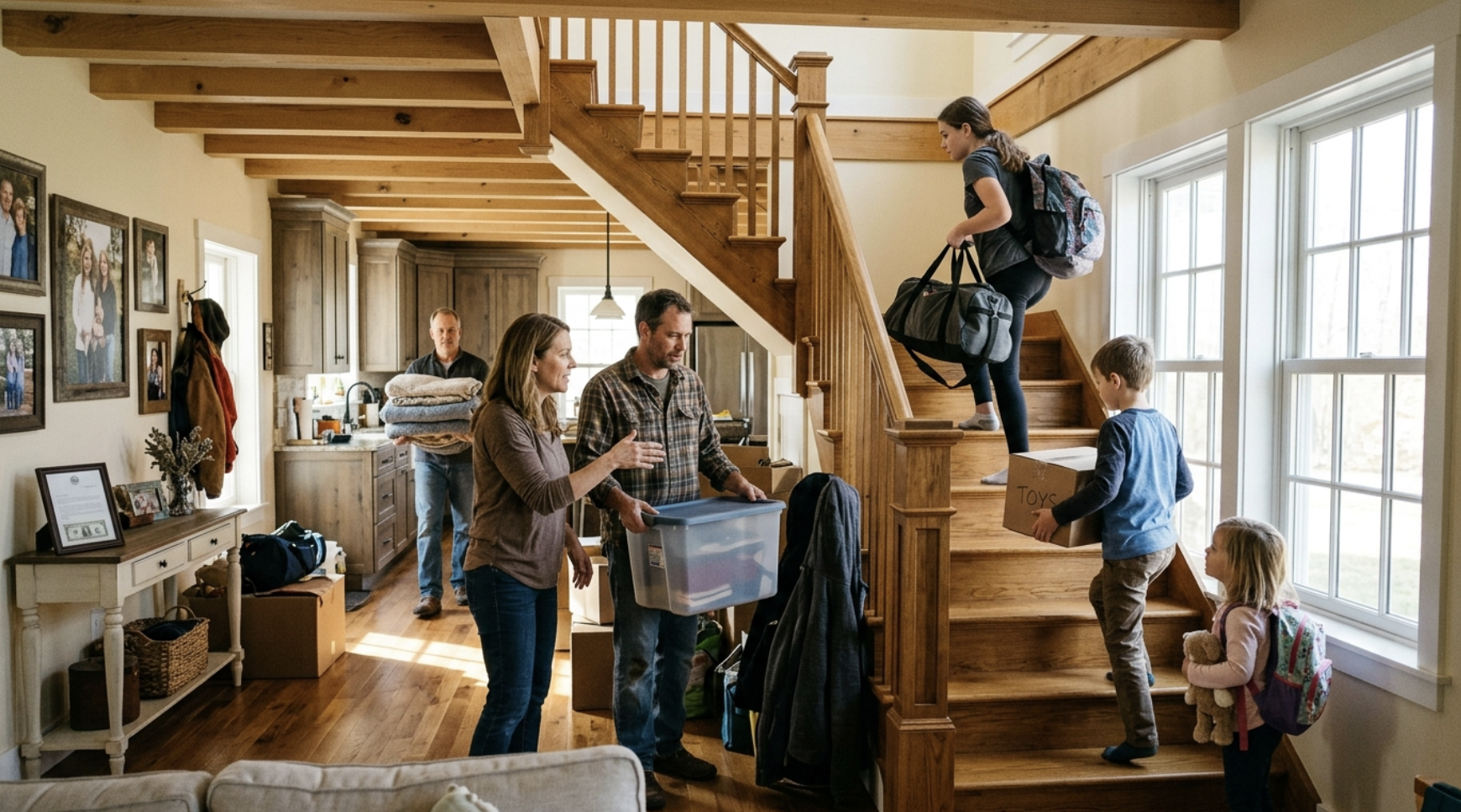
He looked toward the stairs.
“The kids love it here already.”
“I know.”
“Brody asked me if he could plant tomatoes in the garden this spring. Kenzie wants to paint her room yellow. Cole thinks Pickles is going to live forever because Hannah told him goldfish are tough.”
I smiled despite myself.
“Pickles may outlive all of us.”
Jeff laughed softly.
Then his face became serious again.
“I don’t want your house, Tammy. I don’t want you and Dale to lose what you built. But I can’t afford another place right now, and the kids need stability.”
I folded Mom’s letter and returned it to the envelope.
“Then we’re going to make sure they have stability.”
He stared at me.
“What does that mean?”
“It means you’re staying upstairs for now. It means you get a chance to find work that pays enough to support you and the kids. It means the children get to go to school without worrying about where they’ll sleep next month.”
“And Mom and Dad?”
I glanced at the old photograph.
“That’s what Saturday was supposed to be about.”
It was already Sunday morning.
And I had a feeling that our family was about to have the most uncomfortable dinner of its life.
Part 3: The Sunday Dinner Nobody Expected
Mom arrived at eleven-thirty carrying a covered casserole dish.
Dad followed her up the porch steps.
Neither of them knocked.
Mom opened the door and stopped when she saw Kenzie sitting on the living room floor, coloring a picture of the farmhouse.
Cole was beside her, carefully arranging toy cars along the baseboard.
Brody sat at the kitchen table working on his math homework.
Jeff was outside splitting wood with Dale.
Mom looked around the room.
“You’ve moved them in permanently?”
“No,” I said. “I’ve given them somewhere to stay while Jeff gets back on his feet.”
“That isn’t what we discussed.”
“We didn’t discuss anything. You asked me to sell you the house back for a dollar.”
Dad removed his cap.
“Tammy, we were hoping you’d understand.”
“I do understand, Dad. Jeff needs help. His kids need a home. That’s why they’re here.”
Mom set the casserole on the counter.
“But this was supposed to stay a family house.”
I stared at her.
“Mom, Dale and I have spent twenty years making this a family house.”
“I know you’ve done work on it.”
“Sixty thousand dollars’ worth.”
“We never asked you to spend that much.”
“No, you didn’t. But you sold us the property. We made it livable because we wanted a home.”
Dad shifted uncomfortably.
“We never thought you’d take it away from the family.”
I felt something inside me go very still.
“Take it away? Dad, we live here. Hannah grew up here. Her first steps were taken in that hallway. Dale’s mother spent her last Christmas in that living room. This is not an empty building you left behind.”
Mom’s expression changed.
For a moment, I thought she might finally understand.
Then she said something that erased the hope.
“Jeff has children. You have one daughter who’s almost grown. You can start over somewhere else.”
The kitchen went silent.
Even the refrigerator seemed louder.
I looked at my mother, the woman who had taught me to bake biscuits, helped me sew my first dress, and sat beside me when I cried after my first serious breakup.
“You’re asking me to give up my home because you believe my brother’s children need it more than my daughter does?”
“That’s not what I’m saying.”
“Then what are you saying?”
Mom opened her mouth, but no answer came.
Dad finally spoke.
“We’re saying that sometimes family has to make sacrifices.”
I nodded slowly.
“You’re right. Sometimes family does have to make sacrifices.”
I turned toward the window.
“Dale and I sacrificed vacations to pay for the roof. We sacrificed new furniture to replace the furnace. We sacrificed evenings and weekends to make sure the pipes didn’t freeze and the porch didn’t collapse.”
I looked back at them.
“But we chose those sacrifices because we loved this house. Nobody gets to decide that our sacrifices count for less simply because Jeff is having a difficult year.”
Dad looked down at his cap.
Mom’s eyes filled with tears.
I didn’t feel victorious.
I felt exhausted.
Then Jeff came through the back door.
He had heard enough to understand what was happening.
“Mom,” he said, “stop.”
She turned toward him.
“Jeff, we’re trying to help you.”
“No. You’re trying to help me by taking something away from Tammy.”
“We’re your parents.”
“And she’s your daughter.”
The words landed harder than any argument I could have made.
Jeff put the wood down beside the door.
“I didn’t ask Tammy for this house. I asked if I could stay here while I found work. She said yes. That’s enough.”
Mom shook her head.
“But your grandfather’s promise—”
“Grandpa never told me I was entitled to my sister’s home,” Jeff interrupted. “He told me that if I ever fell on hard times, I should be willing to work my way back up.”
Dad looked sharply at him.
“Is that what he told you?”
“Yes. I was sixteen when he said it. I remember because I had broken his old tractor trying to drive it without permission.”
For the first time that morning, Dad almost smiled.
Jeff continued.
“He said a home wasn’t just a building. It was the people who helped you become strong enough to stand on your own.”
He looked at me.
“Tammy has done more than enough.”
Nobody spoke for several seconds.
Then Hannah came downstairs.
She stood at the bottom of the staircase, holding a small framed photograph.
It was a picture of Dale and me on our wedding day, standing on the farmhouse porch.
“I found this behind the books in the upstairs closet,” she said.
Mom looked at it.
Her face went pale.
“Where did you find that?”
“In the same place as the old letter.”
Hannah walked over and handed it to me.
On the back, beneath our wedding date, someone had written another sentence.
May this house always be a place where nobody has to earn the right to be loved.
The handwriting belonged to my grandfather.
I had never seen those words before.
I passed the photograph to Dad.
He stared at it for a long time.
Then, very quietly, he said, “Your grandfather would have been proud of you, Tammy.”
Mom turned away.
For a moment, I thought the conversation was over.
But she had one more thing to say.
“If we leave the house in your hands, will you promise that Jeff and the children can stay as long as they need?”
I considered the question carefully.
“Jeff and the children can stay while we work out an arrangement that is fair to everyone. But I won’t promise that they’ll live here forever. They need a future of their own, and Dale and I need to protect ours.”
Dad nodded.
It wasn’t the answer Mom had wanted.
But it was the only answer I could give honestly.
We ate lunch together that afternoon.
Nobody discussed the dollar again.
For the first time in years, we talked about ordinary things.
Brody’s school project.
Kenzie’s new friendship with Hannah.
Cole’s determination to teach Pickles to swim through a tiny plastic hoop.
And Jeff’s plan to look for a job at the machinery dealership in town.
When Mom left, she hugged me at the door.
It was a stiff, uncertain embrace.
“I’m sorry,” she whispered.
I held her for a moment.
“I know.”
But forgiveness, I was learning, didn’t mean pretending nothing had happened.
It meant deciding what could happen next.
Part 4: The Work of Starting Over
The next three months were not easy.
Jeff found temporary work at a local farm supply store, unloading deliveries and helping customers.
It wasn’t glamorous, and the pay wasn’t great, but he showed up every morning before seven.
He used his evenings to update his résumé and apply for better positions.
Meanwhile, Dale helped him repair his pickup truck, which had been making a terrible grinding noise for weeks.
I helped the children establish routines.
Brody took responsibility for feeding Pickles.
Kenzie helped me prepare dinner twice a week.
Cole learned that the upstairs bathroom was not a swimming pool, despite several determined attempts to test that theory.
The house grew noisier.
It also grew warmer.
Sometimes, when I came downstairs in the morning, I found Jeff sitting at the kitchen table with his head in his hands.
Divorce had left him ashamed.
He worried about the children, the money, and the future.
He worried that people in town knew his marriage had ended.
He worried that he had become the kind of man who needed his little sister to rescue him.
One morning, I poured him coffee and sat across from him.
“You know what the hardest part of this has been for me?” I asked.
He looked up.
“What?”
“Watching you believe that needing help makes you a failure.”
He stared into his mug.
“I should have been able to provide a home for my kids.”
“You did provide a home. Your marriage ended. That doesn’t erase the years you spent raising them.”
“But I’m forty-three years old, living in my sister’s upstairs.”
“Yes,” I said. “And you’re working, paying what you can, taking care of your children, and trying to rebuild your life. That’s not failure, Jeff. That’s getting back up.”
He didn’t answer.
But later that day, I found him repairing the loose railing on the upstairs staircase.
A week later, he fixed the broken gate by the garden.
By the end of the month, he had repaired three windows that hadn’t opened properly in years.
He never asked for praise.
He simply did the work.
Then, in June, he received a phone call from the machinery dealership.
They wanted to interview him for a full-time service manager position.
He got the job.
The salary was better than anything he had earned in years, and it came with health insurance.
For the first time since his wife left, Jeff began to believe that his life might not be over.
One evening, he came into the kitchen holding an envelope.
“I want you to take this,” he said.
I opened it.
Inside was a check for $400.
“What’s this?”
“Rent.”
I looked at him.
“You don’t need to pay me that much right now.”
“I know. But I can afford it.”
“Jeff—”
“Tammy, please.”
His voice was firm.
“I don’t want the kids growing up thinking their father survived because his sister carried him. I want them to know I accepted help, worked hard, and started contributing again.”
I looked at the check.
Then I looked at my brother.
The little boy from the old photograph was still there somewhere, buried beneath years of pride and disappointment.
“All right,” I said. “But we’re putting it toward household expenses and the children’s needs.”
He nodded.
“Fair enough.”
That night, I placed the check in the spiral notebook beside the receipts for the roof, furnace, wiring, and everything else Dale and I had repaired.
For the first time, the notebook didn’t feel like a record of what the house had cost us.
It felt like a record of what a family could build when people stopped keeping score.
But just as our lives began to settle, Mom called.
She asked Dale and me to come over for dinner the following Sunday.
“Your father wants to talk about the farmhouse,” she said.
I felt my stomach tighten.
“Has something changed?”
A long silence followed.
Then Mom said, “There’s something we should have told you before we sold it.”
And suddenly, I was back at that kitchen table in March, watching Dad turn his cap in his hands.
Part 5: The Truth About the Dollar
Mom and Dad’s house looked smaller than I remembered.
They had moved into town years earlier, after Dad decided the farm was too much work.
Their new place had two bedrooms, a narrow driveway, and a little garden Mom maintained with almost religious devotion.
When we arrived, dinner was already on the table.
Dad didn’t touch his food.
Instead, he reached into a drawer and brought out a thick folder.
“I’ve been carrying this around for twenty years,” he said.
He placed it beside my plate.
Inside were old papers from the farmhouse sale, including the deed, the closing documents, and a letter from my grandfather.
Dad had kept the letter folded in a plastic sleeve.
“I should have given this to you when you bought the house,” he said.
“Why didn’t you?”
He rubbed his forehead.
“Because I didn’t know how to explain it.”
I unfolded the letter.
My grandfather had written it shortly before his death.
He described the farmhouse as the place where his children had grown up, where family members had returned after difficult years, and where he hoped future generations would always feel welcome.
But the last paragraph was different.
To my son,
If you ever sell this house, sell it honestly. If you give it to one of your children, do so freely. Do not make a promise on behalf of another person. A gift is only a gift when the person receiving it is allowed to make their own choices.
I read the paragraph twice.
Then I looked at Dad.
“He was talking about the farmhouse.”
“Yes.”
“And you sold it to me freely?”
Dad nodded slowly.
“Yes. We did.”
Mom folded her hands.
“We wanted you and Dale to have a home. We thought we’d done the right thing. But when Jeff’s marriage fell apart, your father became obsessed with the promise he remembered making to his father.”
Dad’s eyes filled with tears.
“I convinced myself that if I could get the farmhouse back, I could keep that promise. I told myself it was only a dollar, that you could start again somewhere else, and that you’d understand because you’re the one who has always been sensible.”
I felt a familiar ache in my chest.
“Being sensible doesn’t mean I don’t get hurt, Dad.”
“I know.”
“Why didn’t you tell me the truth when you asked for the house?”
He stared at the table.
“Because I knew you’d have every right to say no.”
That was the first completely honest thing he had said about the matter.
Mom reached for my hand.
“We were wrong to put that burden on you.”
I thought about the years Dale and I had spent working on the house.
I thought about Hannah’s childhood, the Christmas mornings, the birthday cakes, and the nights when the power went out and we all sat around the fireplace.
I thought about Jeff and his children sleeping upstairs.
Then I thought about my grandfather’s words.
A gift was only a gift when the person receiving it was allowed to make their own choices.
“I don’t want the house back for a dollar,” I said.
Dad looked up.
“I want to keep it. Dale and I have earned the right to decide what happens to our home.”
He nodded.
“I understand.”
“But Jeff and the children will always have a place in our lives. If they need help again, we’ll talk about it. We’ll make a plan. We’ll do what we can.”
Mom squeezed my hand.
“That’s all we should have asked.”
For the first time since March, I believed she meant it.
Dad pushed the folder toward me.
“Keep these papers. They’re yours.”
I placed the letter back inside.
Then I did something I hadn’t planned to do.
I stood, walked around the table, and hugged my father.
He held me tightly.
“I’m sorry, Tammy,” he whispered.
I rested my head against his shoulder.
“I know, Dad.”
It wasn’t a perfect reconciliation.
Twenty years of love didn’t erase one painful mistake, and one apology couldn’t undo the hurt of being told that my home mattered less than someone else’s needs.
But it was a beginning.
And sometimes, a beginning was enough.
Part 6: The House That Stayed
By the following spring, Jeff had saved enough money for a modest rental house a few miles away.
It had three bedrooms, a small backyard, and a garage that needed a new door.
The children were excited.
Brody wanted to choose the color of his room.
Kenzie planned to plant flowers beside the front steps.
Cole announced that Pickles would need his own bedroom.
Jeff laughed harder than I had heard him laugh in years.
On moving day, Dale and I helped carry boxes downstairs.
Mom and Dad came too.
Nobody mentioned the dollar.
Nobody talked about who deserved the farmhouse.
We just worked.
When the last box was loaded into Jeff’s pickup, he stood in the driveway looking at the upstairs windows.
“I don’t know how to thank you,” he said.
“You don’t have to.”
“I mean it, Tam. You gave me time to figure things out when I couldn’t figure anything out myself.”
I smiled.
“You did the hard part.”
He shook his head.
“You gave me somewhere to start.”
Then he hugged me.
The children said goodbye to Hannah, who promised to visit them on weekends.
Kenzie handed me a drawing she’d made.
It showed the farmhouse with flowers around the porch, four stick figures standing in front, and a yellow sun in the corner.
Across the top, in crooked letters, she’d written:
OUR FAMILY HOME.
I held the picture against my chest.
“Thank you, sweetheart.”
She hugged me around the waist.
“Can we still come for Sunday dinner?”
“Every Sunday you want.”
She smiled and ran toward the truck.
As Jeff drove away, Dad stood beside me on the porch.
For a long time, neither of us spoke.
Then he said, “Your grandfather would have liked what you did.”
I looked at him.
“Because I let Jeff stay?”
“Because you helped him without giving up what was yours.”
I watched the pickup disappear down the gravel road.
“That’s what I wanted him to learn,” I said. “That family should help each other stand up. Not ask one person to kneel so another can stand.”
Dad nodded.
A few weeks later, he came to the farmhouse with a small wooden box.
Inside was an old brass key.
It was the original key to the front door, the one my grandfather had used for decades.
“I thought you should have this,” Dad said.
I turned it over in my palm.
“Why now?”
“Because I finally understand something.”
He looked around the kitchen.
“This house doesn’t belong to the family because we say it does. It belongs to you and Dale because you made it your home. And you kept it a place where the family could come together without demanding that anyone give up what they worked for.”
I closed my fingers around the key.
“Thank you, Dad.”
He smiled.
Then, for the first time in twenty years, he knocked before entering the farmhouse.
I opened the door and let him in.
That summer, we held a family barbecue in the backyard.
Jeff brought the children.
Mom brought potato salad.
Dad brought a new birdhouse he had built for the garden.
Hannah and Kenzie sat on the porch steps, laughing over a phone video.
Brody helped Dale turn the burgers on the grill.
Cole ran through the yard carrying a small plastic bowl.
“Pickles is coming to dinner!” he announced.
Everyone laughed.
I stood in the kitchen doorway and watched them.
For years, I’d believed the farmhouse was a collection of repairs, receipts, and sacrifices.
Now I understood that it was something more.
It was the place where my brother had been able to begin again.
It was where my parents had finally learned to apologize.
It was where our children had discovered that love didn’t need to be measured by square footage, money, or who received the biggest gift.
And it was still my home.
That evening, after everyone left, I opened the hutch drawer and took out the spiral notebook.
The final figure on the last page still read $60,340.
Beside it, I wrote a new sentence.
The greatest value of this house was never what we spent to repair it. It was what we learned while making it a home.
Dale came up behind me and rested his chin on my shoulder.
“Finished keeping the books, Mrs. Farmhouse?”
I laughed.
“Almost.”
I closed the notebook and returned it to the drawer.
Then we turned off the kitchen light and walked upstairs together.
Outside, the old farmhouse stood beneath the stars, its roof solid, its windows warm, and its porch waiting for the next Sunday dinner.
My parents had once asked me to give it back for a dollar.
I never did.
But I gave my brother something worth far more than a house.
I gave him the time and space to rebuild his life.
And in the end, I learned that a real family home isn’t the place where everyone gets what they want.
It’s the place where people learn to love one another without taking away what belongs to someone else.
The house stayed ours. The family stayed together. And for the first time in a long time, nobody had to lose a home for someone else to find one.
A year later, we gathered at the farmhouse for Thanksgiving dinner.
Jeff arrived with his three children, carrying a pumpkin pie and a smile I hadn’t seen on his face in years. He had been promoted at work, and the children were thriving in their new home.
Before dinner, Dad stood beside the fireplace and cleared his throat.
“I owe Tammy and Dale another apology,” he said. “I nearly asked them to surrender the home they spent twenty years building because I confused helping my son with taking something from my daughter.”
Nobody interrupted him.
“I hope you both know how sorry I am.”
I walked over and hugged him.
“We’re family, Dad. Let’s do better from now on.”
Mom wiped her eyes, and Jeff put an arm around my shoulders.
That evening, after everyone had gone home, I found a small envelope tucked beneath the old photograph of my grandfather.
Inside was a note Dad had written.
Tammy, you taught me that a family’s love should never come with a demand to surrender what you’ve worked for. Thank you for protecting your home while still opening your door to your brother.
I folded the note and placed it beside my grandfather’s letter.
Then I looked around the kitchen, remembering that cold Tuesday in March when my parents had asked me to give everything back for one dollar.
I had almost lost faith in what family meant.
Instead, I discovered that helping someone doesn’t require destroying what you’ve built, and loving your family doesn’t mean surrendering your boundaries.
Dale came up behind me and wrapped his arms around my waist.
“Still glad you said yes to Jeff staying here?” he whispered.
I smiled.
“Every single day.”
Because I hadn’t given away my home.
I’d given my brother a chance to find his own.
And that was worth far more than one dollar.