PART 3
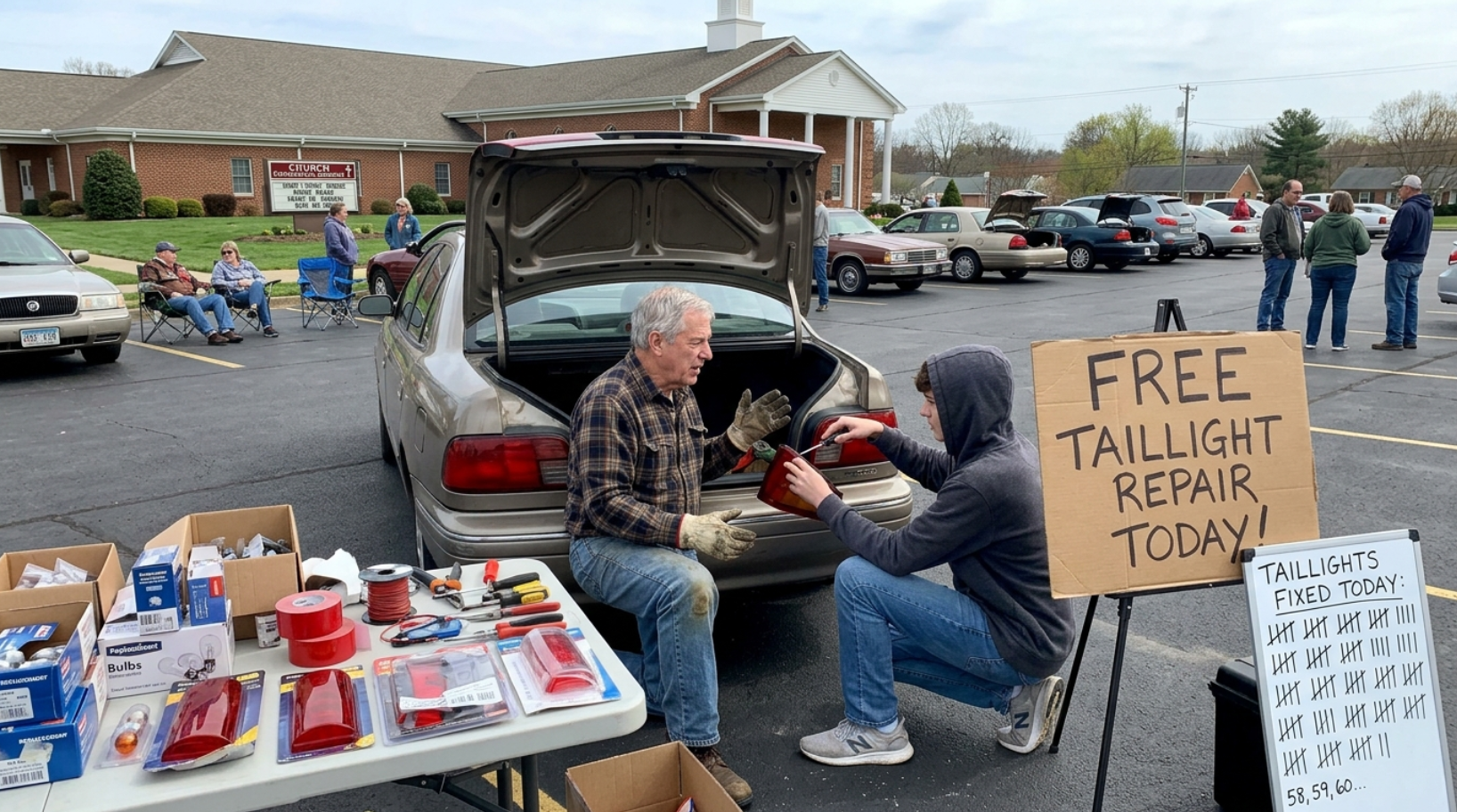
Sixty-four cars, or nearly that many, had come through the church parking lot that afternoon. Farmers, teachers, retirees, young parents, and people who had been driving around for weeks with a burned-out brake light because they couldn’t afford a repair shop.
Craig looked at the cars.
Then he looked at Tyler.
“What exactly is going on here?”
Tyler swallowed.
“Fixing taillights, sir.”
“I’m aware of what taillights are.”
Nobody laughed.
Craig walked toward the table and picked up Hailey’s notebook. She took one small step forward.
“Those are people’s names and license plate numbers,” she said. “Please don’t take that.”
Craig glanced at her.
“Are you telling me what I can do?”
“No,” Hailey answered, her voice trembling. “I’m asking you not to take people’s private information.”
For the first time that afternoon, I felt proud of someone who wasn’t related to me.
Craig shut the notebook and set it down.
“Who authorized this operation?”
“Pastor Ron approved the use of the parking lot,” I said.
“I wasn’t asking you, Marge.”
“You came into my grandson’s workspace. You can ask me anything you like.”
His jaw tightened.
Craig had never liked being challenged in front of other people. He especially disliked it when the person challenging him was an older woman he believed should stay quiet.
He turned back to Tyler.
“Are you charging people?”
“No.”
“Selling parts?”
“No.”
“Collecting donations?”
“Not for us.”
Craig looked at the envelope beside the tools.
“What is that?”
“Money for the food shelf,” Tyler answered. “Walt donated five dollars. We haven’t used any of it.”
Craig opened the envelope and counted the bills.
There were thirty-seven dollars inside.
He looked at me as if he had discovered something suspicious.
“Interesting.”
“What’s interesting?” I asked.
“Nothing yet.”
Those two words landed harder than a shout.
Tyler stood up.
“Craig, we’re just trying to help people.”
Craig turned sharply.
“You don’t get to tell me what you’re doing when I have a legitimate concern.”
“Then tell us what the concern is,” I said.
He ignored me.
Instead, he walked toward the red Ford parked near the church entrance. Walt stood beside it, his hands resting on his cane.
“You,” Craig called. “Is this your vehicle?”
Walt nodded.
“Has someone been working on it?”
“That young man has.”
“Did you give him money?”
Walt looked offended.
“I gave him five dollars for the food shelf.”
“Did he ask you for it?”
“No.”
“Did he promise to do anything in return?”
Walt’s face changed.
“Son, he replaced my brake light because I can’t get down on my knees anymore. He didn’t ask me for a dime.”
Craig’s expression remained hard.
“I’m simply asking questions.”
“And I’m giving you answers.”
The old farmer’s voice wasn’t loud, but it carried across the parking lot.
A few people nodded.
Craig handed the notebook back to Hailey.
“Everybody needs to understand that public safety isn’t a game. If you’re working on vehicles, you need to know what you’re doing.”
Tyler looked down at the tools.
“I know what I’m doing.”
“Do you?”
“Yes.”
“Then you won’t mind if I inspect every vehicle you’ve touched.”
The parking lot went silent again.
I stepped between Craig and the table.
“You may inspect vehicles if you have a lawful reason and follow the proper procedures. But you don’t get to turn a community service project into a personal investigation just because you dislike the boy doing it.”
His eyes narrowed.
“This isn’t about personal feelings.”
“Then it shouldn’t be difficult to explain the actual safety concern.”
Craig stared at me.
Behind him, Hailey’s phone was still recording.
He noticed it.
“Put that phone away.”
Hailey didn’t move.
“I’m recording what is happening in a public parking lot.”
“Did I give you permission to record me?”
“No,” she said. “But I haven’t posted anything. I’m keeping a record of what happens.”
Craig stepped toward her.
I raised my voice for the first time.
“That’s enough.”
He stopped.
I had known Craig for four years. I had watched him intimidate my daughter with his certainty, silence family dinners with his criticism, and make Tyler feel like a guest in a house where he should have been treated like family.
But this was the first time I had seen him surrounded by people who weren’t afraid of disappointing him.
He looked around the parking lot.
Nobody was smiling at him.
Nobody was applauding him.
Nobody was asking him to stay.
Finally, he turned toward his cruiser.
“This isn’t over,” he said.
Then he drove away.
Tyler watched the squad car disappear around the corner.
“Grandma,” he whispered, “is he going to arrest me?”
I put my hand on his shoulder.
“Not for fixing somebody’s brake light.”
“But he can make things difficult.”
“Yes,” I admitted. “He can.”
Tyler looked at the line of waiting cars.
“Then maybe we should stop.”
That hurt more than anything Craig had said.
I looked at my grandson, at the grease on his hands and the red marks on his knees from working on the asphalt.
“Tyler, look at me.”
He did.
“When your car got towed, what did you say?”
“That it wasn’t fair.”
“And what did you do after we got it back?”
“We fixed the light.”
“And what did you decide to do next?”
He looked toward Walt’s Ford.
“Help other people.”
“Has that changed?”
He shook his head.
“Then don’t let someone else’s behavior decide what kind of person you’re going to become.”
Tyler stared at me for a long moment.
Then he picked up the rag.
“Walt, your running lights are good,” he said. “Let’s check your brakes one more time.”
Walt smiled.
“That’s my boy.”
And the work continued.
By five thirty, the final car pulled out of the parking lot.
Sixty-four taillights had been repaired or replaced. Every driver had been told to seek a qualified mechanic if we discovered anything beyond the scope of our simple repairs.
We had spent the afternoon doing something small.
But the effect was bigger than I had imagined.
The church bulletin board was covered with handwritten thank-you notes. Someone had brought sandwiches. A local mechanic had offered to donate his time the following month.
And Hailey had recorded the entire afternoon.
Not just Craig’s arrival.
Everything.
She had footage of Tyler explaining each repair to the car’s owner, of Walt putting his five dollars into the food shelf envelope, and of Pastor Ron thanking the volunteers.
She had the moment Craig demanded to inspect the vehicles, too.
When she finally stopped recording, Tyler leaned against the table and let out a long breath.
“Sixty-four,” he said.
“Sixty-four,” I repeated.
He smiled, but it didn’t last.
“My mom’s going to hear about this.”
I knew he was right.
Lisa would hear about it before dinner. Craig would tell her his version, and by the time she called, she would probably believe that Tyler had embarrassed her husband in front of half the town.
I wished I could tell you I wasn’t worried.
I was.
Because Tyler was my grandson, but Lisa was my daughter.
And sometimes, the hardest battles aren’t fought against strangers.
They’re fought inside the family you have spent your whole life trying to keep together.
Lisa called at 6:12 p.m.
I was washing the grease out of Tyler’s hoodie when my phone began vibrating on the kitchen counter.
Her name appeared on the screen.
I answered.
“What happened today, Mom?”
No hello. No question about Tyler. No mention of the sixty-four people we had helped.
“What did Craig tell you?” I asked.
“He said you and Tyler were running an unauthorized vehicle repair operation in a church parking lot.”
I turned off the faucet.
“That’s an interesting way to describe replacing burned-out bulbs for free.”
“He said there were dozens of cars and people were handing Tyler money.”
“Thirty-seven dollars went into the food shelf envelope.”
“He said he may have to make a report.”
“Then he can make an accurate report.”
Her voice grew sharper.
“Why do you always have to make things difficult?”
I closed my eyes.
There it was.
The question I had heard in a hundred different forms since Craig entered her life.
Why couldn’t I just let things go?
Why did I have to stand up for Tyler?
Why couldn’t I understand that Craig had a difficult job and that he deserved respect?
Because respect was not the same thing as obedience.
But I didn’t say that yet.
Instead, I asked, “Lisa, did you know your husband had Tyler’s car towed?”
Silence.
Then she said, “He told me the taillight was broken.”
“Did you know Tyler had already ordered the replacement part?”
Another silence.
“No.”
“Did you know he bought that car with money he earned himself?”
“Of course I know that.”
“Then why didn’t you ask whether towing it was necessary?”
She sighed.
“Mom, Craig said he was teaching Tyler responsibility.”
“Responsibility doesn’t mean making a teenager lose three hundred dollars over a repair he was already arranging.”
“He has to learn that rules apply to everyone.”
“Agreed. That’s why we replaced the taillight.”
She didn’t answer.
I could hear a television in the background, followed by Craig’s voice asking who she was talking to.
Then Lisa said something that made my stomach tighten.
“He thinks Tyler is deliberately trying to make him look bad.”
I leaned against the counter.
“Did Tyler organize the entire afternoon to embarrass Craig?”
“I don’t know what Tyler was thinking.”
“I do. He was thinking about the people who couldn’t afford to repair their lights.”
“You always take his side.”
“Because I listen to what happened before I decide who is right.”
Her breathing became uneven.
“Craig says you’re turning Tyler against him.”
I looked through the kitchen window.
Tyler was sitting on the back steps, holding his phone. He had probably received another message from his mother.
“Lisa,” I said quietly, “Tyler has lived with me for three years. He has never asked me to hate Craig. He has asked me, more than once, why Craig seems to hate him.”
My daughter didn’t speak.
“He is seventeen,” I continued. “He needs adults who teach him how to make good decisions, not adults who make him feel like every mistake is proof that he doesn’t belong.”
“Craig isn’t trying to make him feel that way.”
“Then I hope Craig thinks about the effect of his actions.”
Lisa’s voice dropped.
“You don’t know what it’s like being married to someone in law enforcement. Everyone watches him. Everyone judges him.”
I felt a small ache in my chest.
For the first time in the conversation, I heard something other than anger.
I heard exhaustion.
“Maybe you’re right,” I said. “I don’t know exactly what it’s like. But I know what it’s like to be a mother who loves her daughter and a grandmother who refuses to let her grandson feel alone.”
She began to cry.
Quietly at first.
Then she said, “I don’t know how to make everybody happy.”
I wished I could reach through the phone and hold her the way I had when she was little.
“You don’t have to make everybody happy, sweetheart. You just have to decide what is right.”
She didn’t answer.
A moment later, Craig called her name again.
Lisa whispered, “I have to go.”
The line went dead.
I stood in the kitchen for a long time, holding the phone.
Then I went outside and sat beside Tyler.
“Was that Mom?” he asked.
“Yes.”
“What did she say?”
I could have lied.
I could have told him she understood, that everything would be fine, and that families always found a way to work things out.
But Tyler was old enough to recognize a comforting lie.
“She is upset,” I said. “And she is caught between two people she loves.”
Tyler looked at the yard.
“Sometimes I don’t think she loves me as much as she loves keeping Craig happy.”
The words were quiet.
They were also the truth as he experienced it.
I put my arm around his shoulders.
“I can’t tell you what your mother feels inside. But I can tell you this: you don’t have to earn the right to be treated with kindness.”
His eyes filled with tears, though he tried to hide them.
“I just wanted him to stop treating me like I’m a problem.”
“I know.”
“I didn’t even want to do all those lights because of him. Not really. I just kept thinking about the people who might get pulled over, or who might get into an accident because somebody couldn’t see them stopping.”
He rubbed his face with his sleeve.
“And then he showed up, and it felt like he could ruin everything again.”
I squeezed his shoulder.
“He doesn’t get to decide whether today mattered.”
Tyler nodded.
Then his phone buzzed.
He looked down at the screen.
It was a message from Hailey.
You should see what people are saying about the video.
He opened the link.
And for the first time that evening, his expression changed.
Hailey had posted a short video of the afternoon with a simple caption:
My boyfriend’s car was towed over a cracked taillight while he was waiting for the replacement part. Instead of getting angry, he and his grandmother spent Saturday fixing taillights for people who couldn’t afford it. Today, they helped sixty-four drivers. This is what community looks like.
She had not named Craig.
She had not insulted the sheriff’s department.
She had not called anyone corrupt.
She had simply shown what happened.
The video had already been shared hundreds of times.
The comments were filling up.
A woman wrote that she had been putting off replacing her brake light because she was trying to choose between car repairs and groceries.
A retired teacher said she had driven to the church after hearing about the project and wished she had brought her own tools.
Someone from a neighboring town offered to organize a similar event.
Then Tyler found Walt’s comment.
That young man treated me with respect when I needed help. His grandmother raised him right.
Tyler read it twice.
Then he handed the phone to me.
“Grandma, look.”
I read the comment and smiled.
“Walt has always known how to say a thing properly.”
But beneath it was another comment, one that changed the atmosphere in our kitchen.
Wasn’t this the kid whose car got towed by Deputy Craig last weekend?
Someone else replied.
Yes. The deputy is his step-grandfather. Or stepfather? Either way, this looks personal.
Within minutes, people were asking questions.
Some defended Craig, saying officers had a difficult job and had to enforce the law.
Others said the tow seemed excessive.
A few went too far, making accusations that nobody could prove.
I told Tyler not to respond to any of it.
“Don’t argue with strangers on the internet,” I said. “You can’t control what they believe. You can control whether you tell the truth.”
He nodded.
Hailey sent another message.
I’m not going to post anything else without talking to you first.
I was grateful for that.
Because the video was already spreading faster than any of us could have imagined.
And when people began asking questions about the towing, the county sheriff had to decide whether to ignore the attention or examine what had happened.
The next morning, he chose the latter.
At 8:30 a.m. on Sunday, my phone rang.
It was Sheriff Miller.
“Margaret, I hope I’m not disturbing you.”
“Not at all.”
“I saw the video circulating online. I also spoke with Deputy Craig after you called me last week.”
I sat down at the kitchen table.
“All right.”
“I want to be careful here. I haven’t reached any conclusions, and a video doesn’t tell us everything. But I am reviewing the traffic stop and the tow. I’d like a copy of the receipt and the paperwork from the towing company.”
“I have both.”
“Good. Could you bring them to the office tomorrow morning?”
“Of course.”
He paused.
“And Margaret?”
“Yes?”
“I want you to know that the department doesn’t authorize officers to use traffic enforcement as a way to settle personal disagreements. If that happened, it would be a serious matter.”
I looked toward the living room, where Tyler was reading a book.
“I’m not asking for special treatment for my grandson, Sheriff.”
“I understand.”
“I just want the same fairness you would offer any other family.”
“That is what I’m trying to establish.”
When we hung up, I gathered the paperwork into a folder.
Tyler walked into the kitchen.
“Was that the sheriff?”
“Yes.”
“Am I in trouble?”
“No.”
“Is Craig?”
“I don’t know, and neither does the sheriff yet.”
Tyler looked relieved, then thoughtful.
“Grandma, if Craig loses his job because of this, Mom might never forgive us.”
I set the folder down.
“Tyler, we didn’t ask anyone to fire him. We asked questions about what happened. What the sheriff decides to do is his responsibility.”
“But everyone will blame us.”
“Some people might. That doesn’t mean we did something wrong.”
He leaned against the doorway.
“I don’t want Mom to lose her marriage.”
I looked at my grandson and saw how much he had been carrying without telling me.
At seventeen, he was worrying about his own future, his relationship with his mother, his stepfather’s career, and the possibility that speaking honestly could hurt people he loved.
“Listen to me,” I said. “You are not responsible for keeping an adult marriage together. That’s not your job. Your job is to grow into a good man, learn from your mistakes, and treat people fairly.”
He looked down at his hands.
“I wish everybody understood that.”
“So do I.”
I gave him the folder to put in my handbag.
Then I added, “And one more thing.”
“What?”
“Next Saturday, we’re buying more bulbs.”
He stared at me.
“Seriously?”
“Seriously. I heard the pastor say three people asked whether we could do it again.”
A slow smile spread across his face.
“How many?”
“As many as we can safely help.”
For the first time since the squad car had entered the church parking lot, Tyler laughed.
It was a small laugh.
But it was enough.
We didn’t know what the sheriff would find. We didn’t know what Lisa would say when she learned the department was reviewing the stop. And we certainly didn’t know how Craig would react when he realized the story was no longer something he could control simply by raising his voice.
All we knew was that the next Saturday, there would be more cars waiting outside the church.
And Tyler intended to be there.
PART 4
Monday morning, I drove to the county sheriff’s office with the towing receipt, the vehicle release paperwork, and a copy of the order Craig had written that night.
Tyler wanted to come with me.
I told him he didn’t have to.
He came anyway.
We sat across from Sheriff Miller in a small office that smelled of coffee and printer paper. He examined the paperwork carefully, asking when Tyler had ordered the replacement taillight, when it had been expected to arrive, and whether Craig had explained why the vehicle needed to be towed rather than allowing Tyler to arrange a repair.
I answered what I knew.
Tyler answered the rest.
When we finished, the sheriff folded his hands on the desk.
“I want to be clear about something,” he said. “This review isn’t about whether Deputy Craig likes your family. It’s about whether he followed department policy and whether his actions were justified.”
Tyler nodded.
“That’s all we want,” I said.
Sheriff Miller looked at my grandson.
“Tyler, I know this situation has been difficult. I also want you to understand that traffic laws exist for a reason. If your vehicle isn’t safe, you need to fix it.”
“I understand, sir.”
“And if an officer stops you, remain calm and follow lawful instructions.”
“Yes, sir.”
The sheriff glanced at the documents again.
“But there is a difference between enforcing a safety requirement and using enforcement to punish someone. That’s what we need to determine here.”
For the first time since that Saturday night, Tyler looked as though someone in authority was listening to him rather than looking for a reason to blame him.
We thanked the sheriff and left.
Outside, Tyler stood beside my car, staring at the courthouse across the street.
“Grandma?”
“Yes?”
“What if he says Craig did nothing wrong?”
I considered the question.
“Then we’ll accept the decision if it’s supported by the facts. And if we disagree, we’ll ask what options we have. But we won’t invent anything, and we won’t exaggerate.”
Tyler nodded.
“And what if he says Craig was wrong?”
“Then Craig will have to take responsibility for what he did.”
Tyler opened the passenger door.
“I hope he does.”
“So do I.”
But neither of us was prepared for what happened that afternoon.
Because at 3:17 p.m., my daughter Lisa appeared at my front door.
And she was crying.
I found her standing on the porch with her purse hanging from one shoulder and her wedding ring twisted around her finger.
She looked exhausted.
“Mom, can I come in?”
“Of course.”
She walked into the living room and sat down without removing her coat.
Tyler was in the garage organizing the tools we had used at the church. He heard her voice and came to the doorway.
“Mom?”
Lisa looked at him.
For a moment, neither of them moved.
Then she stood.
“Oh, Tyler.”
She crossed the room and wrapped her arms around him.
My grandson stiffened at first. Their relationship had been strained for so long that affection had become something he didn’t quite know how to receive.
Then he hugged her back.
Lisa began to cry harder.
“I’m sorry,” she whispered.
Tyler didn’t answer immediately.
She pulled back enough to look at his face.
“I should have asked you what happened with your car. I should have listened to you before I listened to everyone else.”
He swallowed.
“It’s okay, Mom.”
“No.” She shook her head. “It wasn’t okay. And I don’t want to pretend it was.”
I turned toward the kitchen to give them a little privacy, but Lisa reached for my hand.
“Please stay, Mom. I need to say this to both of you.”
So I sat down.
Lisa wiped her eyes.
“Craig told me he was teaching Tyler responsibility. He made it sound as though Tyler had been careless and disrespectful, and I believed him because I wanted to believe my husband was handling things properly.”
She looked at Tyler.
“But you had already ordered the part, hadn’t you?”
“Yes.”
“And you paid for it yourself?”
“Yes.”
She pressed her lips together.
“I didn’t even ask to see the receipt.”
Tyler shrugged, looking uncomfortable.
“It’s just a taillight, Mom.”
“No, sweetheart. It isn’t just a taillight.”
Her voice broke.
“It’s the fact that you did everything you were supposed to do, and I didn’t give you the chance to explain.”
The room went quiet.
I watched my daughter struggle with something I had seen her avoid for years: the possibility that keeping peace in her marriage had come at the cost of her relationship with her son.
Finally, she turned toward me.
“I need to tell you something else.”
I waited.
“Craig is furious about the video. He says people are making him look like a monster.”
“Did Hailey call him one?” I asked.
“No.”
“Did Tyler?”
“No.”
“Did I?”
Lisa shook her head.
“Then perhaps he needs to consider why the facts are making him uncomfortable.”
She stared at the floor.
“He says you are trying to get him fired.”
“Lisa, I have never asked anyone to fire your husband.”
“But you want him held accountable.”
“Yes.”
She looked up.
“And if that costs him his job?”
I took a breath.
“That’s a decision for the department, based on what happened. I won’t lie to protect him, and I won’t lie to hurt him. I will tell the truth.”
Lisa nodded slowly.
“I think that’s fair.”
It was the first time I had heard her say those words without immediately following them with a reason to defend Craig.
Tyler sat beside her.
“Mom, I don’t want Craig to lose his job.”
She reached for his hand.
“I know.”
“I just want him to stop treating me like I’m always doing something wrong.”
Lisa closed her eyes.
“I know that now, too.”
For a few minutes, the three of us sat together.
Nobody promised that everything would be fixed overnight.
Nobody pretended that an apology could erase four years of hurt.
But something had changed.
For the first time in a long time, Lisa was listening.
And Tyler was finally being heard.
The next Saturday, we returned to the church parking lot.
I expected twenty cars.
We had prepared enough bulbs for thirty.
By 8:30 a.m., there were already seventeen vehicles waiting.
Pastor Ron stood beside the entrance, directing traffic. Dale from the parts store arrived with two boxes of additional bulbs. Hailey brought a fresh notebook, and Walt showed up carrying a thermos of coffee large enough to serve an entire construction crew.
“You people are going to make an old man famous,” he announced.
Tyler laughed.
“Only if you let us fix your truck again.”
“Not a chance. That thing is running better than it has in ten years.”
The atmosphere was different this time.
People weren’t just coming for repairs.
They were coming to help.
A retired mechanic offered to inspect brake lights and wiring. Two high school students volunteered to organize tools. A local business donated work gloves and safety vests.
One woman arrived with a bag of sandwiches and a note that read:
I couldn’t afford to replace my light last month. Thank you for making people like me feel less embarrassed to ask for help.
Tyler read it and carefully folded the note into his pocket.
By noon, we had repaired another thirty-eight lights.
Then a silver sedan pulled into the parking lot.
I recognized the driver immediately.
Craig.
He was not in uniform.
He stepped out wearing jeans and a plain gray jacket. For a moment, he stood beside his car, looking at the volunteers.
Tyler noticed him.
His hands stopped moving.
Hailey glanced at me.
I gave her a small nod, telling her not to make a scene.
Craig walked toward us.
“Tyler,” he said.
My grandson straightened.
“Craig.”
The word was respectful but distant.
Craig looked at the tools on the table.
“I heard you’re doing this again.”
“We are,” Tyler replied.
Craig nodded.
“Looks like a lot of people showed up.”
“They need the help.”
Craig glanced toward the line of cars.
“Can I talk to you for a minute?”
Tyler looked at me.
I didn’t answer for him.
This was his decision.
After a moment, he nodded.
They walked several feet away, stopping near the church’s side entrance.
I couldn’t hear every word, but I could see Craig’s hands moving as he spoke.
Then Tyler said something.
Craig stopped gesturing.
His shoulders lowered.
They continued talking for another minute before returning.
Tyler walked back to the worktable without saying anything.
Craig remained beside the car.
I approached him.
“Are you here to see Tyler?”
He nodded.
“I wanted to talk to him.”
“Did you?”
“Yes.”
He looked uncomfortable.
“I also wanted to speak with you, Marge.”
I waited.
Craig took a breath.
“I was wrong to have his car towed the way I did.”
The words were quiet.
For a moment, I wasn’t certain I had heard him correctly.
He continued.
“I knew he had ordered the part. I knew he was planning to fix it. I told myself I was teaching him responsibility, but I let my frustration with him influence how I handled the stop.”
He looked toward Tyler.
“I should have handled it differently.”
I studied his face.
“Why are you telling us this now?”
Craig looked down.
“Because the sheriff reviewed the incident, and I had to explain my decisions. Because I realized the video wasn’t the only thing people were looking at. And because I finally had to look at what I actually did.”
He paused.
“I don’t expect everyone to forgive me because I said I’m sorry.”
That surprised me more than the apology itself.
For once, he wasn’t demanding that an apology immediately restore his authority.
“What do you expect?” I asked.
“To do better.”
I nodded slowly.
“Then start by doing it.”
Craig looked at me.
I continued.
“Tyler doesn’t need another speech about responsibility. He needs you to treat him fairly, even when you’re frustrated with him. He needs you to correct him when he’s wrong without assuming the worst about him. And he needs to know that being part of this family doesn’t mean he has to prove himself to you every single day.”
Craig swallowed.
“I understand.”
“Do you?”
He looked toward Tyler again.
“I think I’m beginning to.”
It wasn’t a perfect answer.
But it was the first honest one I had heard from him in years.
That afternoon, Sheriff Miller called.
The department’s review had concluded that Craig’s handling of the stop was inconsistent with its expectations for impartial enforcement. The sheriff had issued formal discipline and required additional training on discretion and professional conduct.
The sheriff did not discuss private personnel details with us, and I did not ask him to.
He also made it clear that Tyler had not been accused of any wrongdoing in connection with the church project.
I thanked him.
Then I told Tyler.
He listened quietly.
“Is Craig going to lose his job?”
“The sheriff didn’t say that, and we shouldn’t guess.”
Tyler nodded.
“Okay.”
I studied his face.
“Are you disappointed?”
He shook his head.
“No. I just wanted someone to look at what happened and decide fairly.”
“That is what happened.”
He looked toward the parking lot, where Craig was helping Dale carry a box of bulbs.
“Grandma?”
“Yes?”
“I think I can forgive him someday.”
I smiled gently.
“You don’t have to rush that decision.”
“I know.”
He looked down at his greasy hands.
“But I don’t want to spend the rest of my life being angry.”
I pulled him into a hug.
“Then don’t. Just remember that forgiveness doesn’t mean you have to accept the same treatment again.”
He hugged me back.
“I won’t.”
Across the parking lot, Craig glanced in our direction.
For once, he didn’t call Tyler over to correct him.
He simply returned to work.
And that small decision mattered more than he probably realized.
The following weeks brought changes that no one in our family had expected.
Craig began attending some of the community repair events, always in plain clothes and never using his position to direct anyone.
At first, people watched him carefully.
Some refused to speak to him.
Others were willing to give him a chance.
He didn’t complain.
He carried boxes, cleaned tools, and listened when the mechanic explained why certain repairs needed professional attention.
One afternoon, I found him standing beside Walt’s truck.
Walt was explaining how he had driven the same vehicle for nearly twenty years.
Craig listened without interrupting.
Later, he came over to me.
“I never realized how much people worry about small repairs,” he said.
I looked toward the line of vehicles.
“For some people, a forty-dollar part means giving up groceries for the week.”
He nodded.
“I know that now.”
“Knowing it is a start.”
He looked at Tyler, who was helping a young mother understand why her brake light wasn’t working.
“I was hard on him because I thought he needed to become tougher.”
“Tyler is already tough,” I said. “He just doesn’t believe that being tough means making other people feel small.”
Craig was quiet for a moment.
Then he said, “I wish I’d understood that sooner.”
“So do I.”
Our relationship didn’t transform overnight.
There were still awkward family dinners. There were still moments when Craig slipped into his old habit of correcting Tyler before hearing the whole story.
But now, when that happened, Lisa spoke up.
“Craig, let him finish.”
Sometimes he listened immediately.
Sometimes he needed a minute.
But he began trying.
And Lisa began doing something even more important.
She stopped asking Tyler to keep quiet simply to avoid upsetting her husband.
One evening, she called me and said, “Mom, I thought a peaceful home meant nobody argued. I didn’t realize that sometimes it meant one person was swallowing everything they wanted to say.”
I sat quietly on the other end of the phone.
“It’s difficult to recognize that when you’re living inside it,” I told her.
“I know. I wish I’d seen it sooner.”
“You’re seeing it now.”
She sighed.
“Do you think Tyler will ever trust me the way he used to?”
I looked at the photograph on my kitchen shelf: Lisa at sixteen, standing beside Tyler’s father, holding their newborn son.
“Trust takes time,” I said. “But you can start earning it today.”
And she did.
She began visiting Tyler every Wednesday evening.
Sometimes they cooked dinner together. Sometimes they went for a drive. Sometimes they talked about school, college applications, and his plans after graduation.
She stopped making promises she couldn’t keep.
She stopped asking him to pretend that the past hadn’t happened.
Slowly, their relationship began to heal.
Not because Craig had apologized.
Not because the video had gone viral.
But because Lisa finally understood that being a mother required more than loving her son in private.
It required standing beside him when it mattered.
Three months later, the church held a community appreciation dinner.
There were folding tables in the fellowship hall, paper plates stacked beside the serving dishes, and flowers in old glass jars.
Walt brought a pie.
Dale brought more bulbs than anyone could reasonably use in a year.
Pastor Ron stood at the front and thanked the volunteers.
Then he called Tyler’s name.
My grandson looked horrified.
“Grandma, no.”
I smiled.
“Go on.”
He walked to the front, his face turning red as people applauded.
Pastor Ron handed him a small framed certificate recognizing his volunteer service.
Then he gave me one, too.
“For Marge,” he said, “who reminded all of us that when something goes wrong, we don’t always have to respond with anger. Sometimes we can respond by helping the next person.”
People applauded again.
I wiped my eyes.
But the moment I remember most clearly came afterward.
Craig approached Tyler while I was helping clear the dessert table.
He carried a small envelope.
“Tyler,” he said, “I wanted to give you something.”
Tyler opened it.
Inside was $280.
The exact amount I had paid to release the Grand Prix.
Tyler stared at the money.
“What is this?”
Craig took a breath.
“It’s what your grandmother paid to get your car back. I should never have put your family in that position, and I want to repay the cost.”
Tyler looked at him for a long moment.
“You don’t have to do this.”
“Yes,” Craig said. “I do.”
Tyler closed the envelope.
“Thank you.”
Craig nodded.
Then, after a moment, he added, “And I owe you another apology. Not just for the tow. For the way I’ve treated you since I married your mother.”
The noise in the fellowship hall seemed to fade around them.
Craig continued.
“I kept expecting you to prove you deserved my respect. I didn’t stop to consider that you deserved it already.”
Tyler’s eyes shone.
“I wanted you to like me,” he admitted.
Craig looked down.
“I know.”
“I tried really hard.”
“I know that now, too.”
For a moment, neither of them spoke.
Then Craig held out his hand.
Tyler looked at it.
Instead of shaking it, he stepped forward and gave Craig a brief, awkward hug.
Craig froze for half a second.
Then he returned it.
I turned away before they could see me crying.
Not because everything had been repaired.
But because something had finally begun.
A year after the first taillight was replaced, Tyler graduated from high school.
He had been accepted into a technical college, where he planned to study automotive technology.
He wanted to become a mechanic.
Not because he hated law enforcement.
Not because he wanted to prove Craig wrong.
But because he had discovered something important in that church parking lot.
A broken part didn’t make a person broken.
And helping someone fix a problem could change far more than the machine itself.
On graduation day, I sat between Lisa and Hailey in the school auditorium.
Craig sat on Lisa’s other side.
When Tyler’s name was called, we all stood.
He crossed the stage with his usual crooked smile, accepted his diploma, and looked directly toward us.
I cheered so loudly that Lisa laughed.
Afterward, we gathered in the parking lot for photographs.
Tyler hugged his mother first.
Then Hailey.
Then me.
When he reached Craig, they shook hands before Craig pulled him into a hug.
It wasn’t the embrace of a perfect father and son.
It was the embrace of two people who had hurt each other, acknowledged it, and decided to try again.
That was enough for that day.
Later, as we drove home, Tyler sat in the passenger seat of his Grand Prix.
The car was still running beautifully.
Its taillights shone red in the afternoon sun.
He looked at me and smiled.
“Grandma, remember when you said we should stand behind people?”
“I remember.”
“I think that was the best thing anyone ever taught me.”
I laughed softly.
“You learned that from yourself, sweetheart.”
He shook his head.
“No. I learned it because you stood behind me first.”
I had to look away for a moment.
Because he was right.
That was what the whole story had been about.
Not a cracked taillight.
Not a tow truck.
Not a viral video or a deputy’s discipline.
It was about what happens when a young person makes a mistake—or even when he doesn’t—and the adults around him choose whether to humiliate him or help him grow.
Craig had believed authority meant making Tyler obey.
I had believed love meant making sure Tyler knew he mattered.
Eventually, Craig began to understand that respect could not be forced, and Tyler learned that he could stand up for himself without becoming bitter.
And Lisa learned that keeping peace at any cost wasn’t the same as keeping a family together.
As for me, I learned something, too.
Sometimes the strongest response to being wronged isn’t revenge.
It’s refusing to let the wrong turn you into someone you don’t want to be.
Two Saturdays later, we held another free repair day at the church.
This time, Tyler led the volunteers himself.
He wore a clean work shirt with his name stitched over the pocket. Hailey managed the sign-in table, Dale supplied the bulbs, and Pastor Ron directed cars into the lot.
Craig arrived halfway through the morning.
He parked his own vehicle and walked over to Tyler.
“Where do you need me?”
Tyler pointed toward a stack of boxes.
“Could you help Dale organize those?”
“Sure.”
And that was all.
No speech.
No argument.
No demand for recognition.
Just a man asking how he could help.
By the end of the afternoon, we had assisted fifty-one drivers.
As the last car pulled away, Tyler stood beside me near the church steps.
The sky was turning gold, and the bell tower cast a long shadow across the parking lot.
“Grandma,” he said, “do you think the whole thing would have happened if Craig hadn’t towed my car?”
I considered that.
“Probably not in exactly the same way.”
He nodded.
“It’s strange. That night, I thought everything had gone wrong.”
“And now?”
He looked across the parking lot at the people packing away the tools.
“Now I think something good came out of it.”
I smiled.
“That’s often how life works. It doesn’t make the bad thing right. It just means the bad thing doesn’t get to be the end of the story.”
Tyler leaned his head against my shoulder.
Then he said something I will carry with me for the rest of my life.
“I’m glad you were there.”
I squeezed his hand.
“Always, sweetheart.”
And as we walked toward the car, I glanced back at the church parking lot.
Sixty-four taillights had started it all.
But the greatest thing we repaired that year wasn’t a single light on a vehicle.
It was a family that had forgotten how to listen.
We didn’t fix it in one afternoon. We didn’t fix it with a viral video or a perfect apology.
We fixed it one honest conversation at a time.
One boundary at a time.
One act of kindness at a time.
And that, I finally understood, was the kind of lesson worth teaching.